‘Sweeping and regret-inducing’
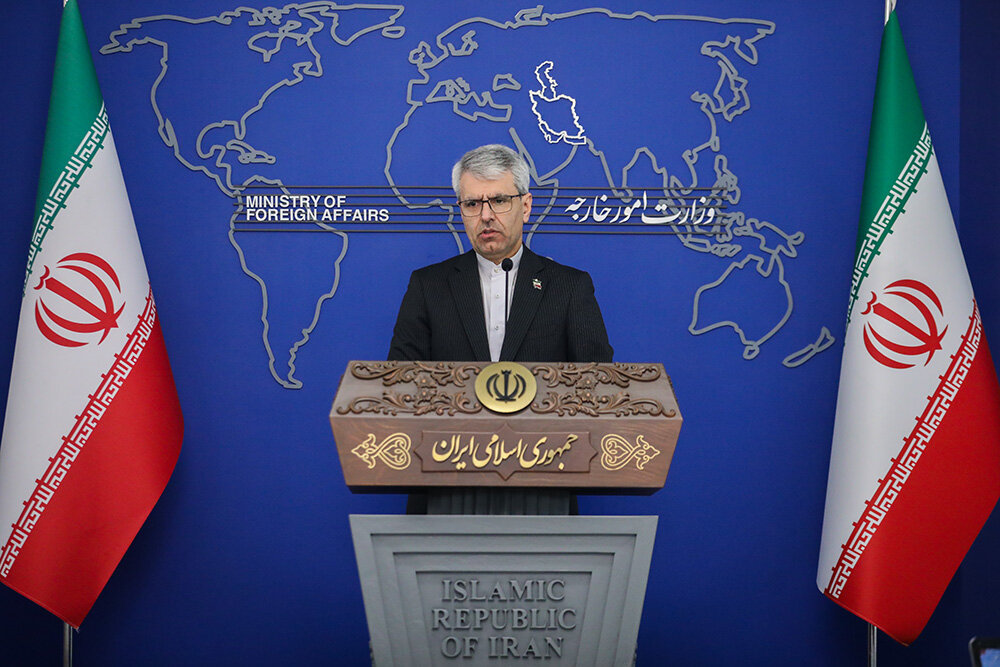
TEHRAN — Foreign Ministry spokesman Esmail Baqaei issued a definitive warning on January 26, declaring that the Islamic Republic is fully prepared to deliver a “sweeping, regret-inducing response” to any act of aggression.
Addressing reporters during his weekly press briefing, Baqaei emphasized that Tehran remains confident in its deterrent capabilities, bolstered by the “heroic battle” in June 2025—a 12-day conflict in which Iranian forces decisively repelled a multi-front military incursion.
The spokesman noted that the nation is now more capable than ever of defending its sovereignty against the persistent threats posed by the United States and Israel.
Baqaei categorized the current regional tension as an extension of a “hybrid war” aimed at undermining the Islamic Republic through a combination of military intimidation and psychological operations.
This assessment follows a visible and provocative buildup of U.S. military assets, openly confirmed by U.S. Central Command (CENTCOM).
The USS Abraham Lincoln carrier strike group has entered the region, a move CENTCOM describes as “promoting regional security” but which Tehran views as a hostile show of force.
CENTCOM has also publicized a multi-day U.S. Air Force readiness exercise in the region.
Baqaei dismissed these moves as provocative violations of international law, asserting that the arrival of foreign fleets would not weaken Iran’s “valiant will” to protect its territory.
He cautioned that regional insecurity is “contagious,” warning that any miscalculation by Washington would inevitably destabilize the entire Middle East, affecting even those who facilitate such aggression.
The resolve in Tehran has been further clarified by other officials in recent days, setting explicit redlines for any potential escalation.
On January 18, President Masoud Pezeshkian warned that any hostile action directed toward the Leader of the Islamic Revolution, Ayatollah Seyyed Ali Khamenei, would constitute a “full-fledged war” with the entire Iranian nation.
This sentiment was echoed on January 20 by Brigadier General Abolfazl Shekarchi, spokesperson for the General Staff of the Armed Forces, who delivered a blunt message to the White House: “Trump knows that if a hand of aggression is extended toward our Leader, we will not only cut that hand—decisively and courageously—but we will set their world on fire and deny them any peace.”
Tehran’s stance was also reinforced by a senior Iranian official who reportedly told Reuters that Iran no longer distinguishes between scales of conflict.
“This time we will treat any attack—limited, surgical, or kinetic—as an all-out war,” the official stated, promising the “hardest way possible” to settle the account.
Rejection of ‘Zionist fabrications’
In a direct rebuttal of recent reports circulated by Israeli media, Baqaei characterized claims of secret diplomatic guarantees as “absolute fabrications.”
He specifically denied allegations that U.S. official Steve Witkoff had received messages from Foreign Minister Abbas Araghchi or a written guarantee from President Pezeshkian to delay a military strike.
“The Zionist regime is a primary source of fake news and is fundamentally hostile to any form of diplomacy,” Baqaei stated.
He added that such “big lies” are systematically injected into U.S. decision-making circles to provoke a dangerous escalation, comparing the tactics to historical propaganda intended for maximum deception.
He cited recent false reports regarding mass executions as evidence of this coordinated disinformation campaign designed to mislead the international community and justify foreign intervention.
Unmasking the strategy of ‘internal engineering’
Reinforcing this stance from a domestic security perspective, Ali Larijani, the Secretary of the Supreme National Security Council, warned on January 26 that the U.S. has shifted its strategy toward inciting social crises as a pretext for military intervention.
Speaking at a gathering of military commanders, Larijani argued that Trump “gave it away” by suggesting that military operations would follow if social unrest in Iran was escalated.
Larijani described recent rioters as “semi-terrorist urban groups” linked to Israeli-backed structures, specifically targeting national symbols such as the flag and statues of martyr General Qassem Soleimani.
“The enemy seeks to break the solidarity that was our greatest strength during the June war,” Larijani said, noting that the Iranian people demonstrated their unwavering loyalty during the massive Dey 22 (January 12) rallies.
Diplomatic redlines and regional stances
On the diplomatic front, Iran’s Permanent Representative to the UN in Geneva, Ali Bahraini, reaffirmed that Tehran is prepared for “every scenario.”
While dismissing the predictability of a U.S. administration that disregards the UN Charter, Bahraini clarified that although informal messages are occasionally exchanged via third parties, no substantive negotiations are currently underway.
He reminded reporters that Washington previously sabotaged indirect talks by colluding with Israel in the June 2025 attacks, thereby destroying the necessary trust for a diplomatic breakthrough.
Amid these escalations, the United Arab Emirates has taken a step toward regional de-escalation.
The UAE Ministry of Foreign Affairs reaffirmed its commitment to not allowing its airspace, territory, or waters to be used in any hostile military actions against Iran.
This refusal to provide logistical support for U.S.-led aggression underscores a growing consensus among Persian Gulf neighbors that diplomatic dialogue and respect for sovereignty are the only viable paths forward.
Leave a Comment